 | And Pollution
Products
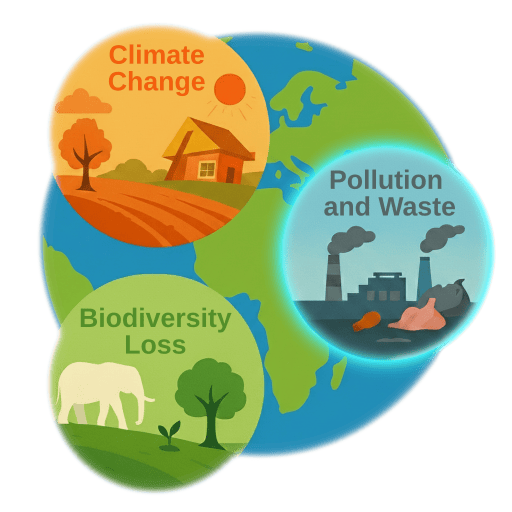
Explore illustrations of products associated with global pollutants and wastes.







Products by Pollution Categories
Beyond Consumption: The Hidden Pollution Footprint of Everyday Products
From household cleaners and plastic packaging to agricultural fertilizers, industrial chemicals, and fossil fuels, countless products and materials contribute to pollution throughout their life cycles. Their manufacture, use, and disposal release substances that contaminate the air, water, and soil, threaten human health, disrupt ecosystems, and contribute to climate change.
Explore 50+ pollutants and pollution indicators across eight categories, illustrated through everyday products, industrial infrastructure, and environmental pathways, to uncover the often-overlooked connections between what we produce, consume, and discard—and the pollution pressures facing people and the planet.
Air (non-GHG) pollutants
Greenhouse gases
Heavy metals and toxic elements
Nutrients and water pollutants
Persistent organic pollutants, POPs
PFAS forever chemicals
Plastics and polymers, solid waste
Wastewater and industrial indicators
Source: Pollutant descriptions and associated activities were synthesized using Google Gemini AI (2025), based on consensus data from the WHO, UNEP, IPCC, and other international sources.
UNU-KEY: Electrical and Electronic Equipment Categories
Beyond the Bin: The Hidden Diversity of Electronic Waste
From refrigerators and smartphones to medical devices, industrial machinery, and solar panels, electrical and electronic equipment powers nearly every aspect of modern life. Yet behind this technological convenience lies an extraordinary diversity of products, materials, and environmental challenges.
Explore 50+ categories of electrical and electronic equipment, classified by the United Nations University (UNU), to discover the vast spectrum of devices that eventually become e-waste—and why responsible reuse, repair, and recycling matter for people and the planet.
Lamps
(Lamps: small mass, serious mercury concerns)
Large Equipment (excluding photovoltaic panels)
(Bulky appliances, major recovery opportunities)
Photovoltaic Panels (including converters)
(Solar panels: a rising future waste stream)
Screens, Monitors, and Equipment Containing Screens
(Screens with a hazardous materials legacy)
Small Equipment
(Small devices, the largest e-waste stream)
Small IT and Telecommunication Equipment
(Connected devices, growing material demands)
Temperature Exchange Equipment
(Cooling equipment: hidden climate risks)
Source: Cornelis P. Baldé, Ruediger Kuehr, Tales Yamamoto, Rosie McDonald, Elena D’Angelo, Shahana Althaf, Garam Bel, Otmar Deubzer, Elena Fernandez-Cubillo, Vanessa Forti, Vanessa Gray, Sunil Herat, Shunichi Honda, Giulia Iattoni, Deepali S. Khetriwal, Vittoria Luda di Cortemiglia, Yuliya Lobuntsova, Innocent Nnorom, Noémie Pralat, Michelle Wagner (2024). International Telecom-munication Union (ITU) and United Nations Institute for Training and Research (UNITAR). 2024. Global E-waste Monitor 2024. Geneva/Bonn.
Basel Action Network: AI Infrastructure Categories
Beyond GPUs: The Hidden Infrastructure of AI E-waste
Artificial intelligence depends on much more than processors and servers. Data centers contain extensive electrical, networking, cooling, and backup-power systems, all requiring materials and eventual maintenance or replacement. Understanding these interconnected systems reveals the broader physical footprint of AI infrastructure.
Accelerators, Servers, and Racks
(The computing engines behind AI)
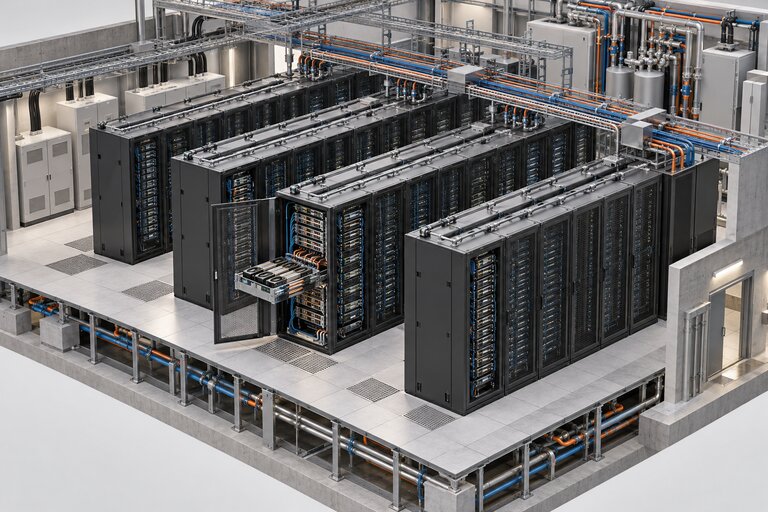
High-density GPU racks; rack-mounted GPU servers; accelerator trays; circuit boards; cold plates; rack power strips
Description: Dense racks of purpose-built accelerators and servers provide parallel computing capacity for AI workloads. Their assemblies include GPUs or other accelerators, CPUs, memory, circuit boards, network cards, solid-state drives, power supplies, and cold plates or heatsinks.
Environment Impact: Specialized accelerator generations may have relatively short refresh cycles and narrower opportunities for secondary use. Retired assemblies require responsible electronics reuse, refurbishment, and materials recovery.
For every 100 MW facility:
- 910 tonnes
- 13% of equipment mass
- 2.5-year assumed replacement cycle
Networking Equipment
(The connections that keep AI clusters working together)
Description: High-throughput switches, optical modules, adapters, and copper and fiber cabling connect servers and accelerators into tightly coordinated computing clusters.
Environment Impact: Successive bandwidth upgrades can retire switches, optical transceivers, and cabling while still functional, creating circuit-board and metal-rich waste streams.
For every 100 MW facility:
- 210 tonnes
- 3% of equipment mass
- 3.5-year assumed replacement cycle
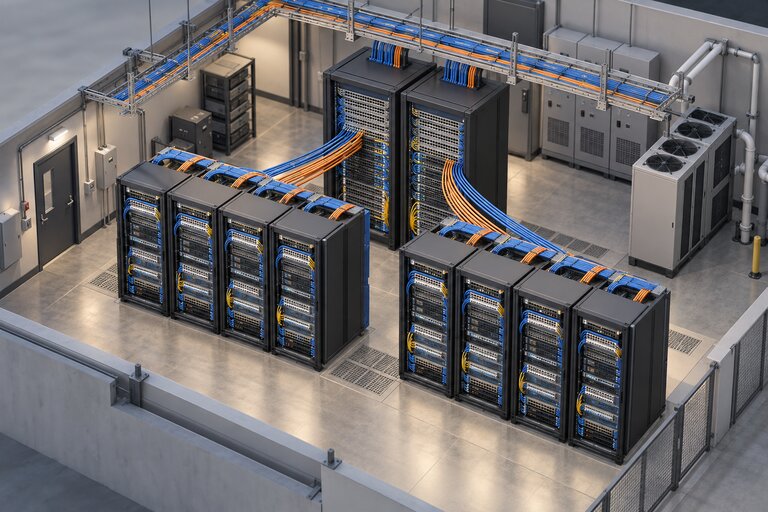
Top-of-rack switches; spine switches; optical transceivers; fiber-optic patch panels; copper cables; network racks
Power Supply and Distribution
(The electrical backbone of AI infrastructure)
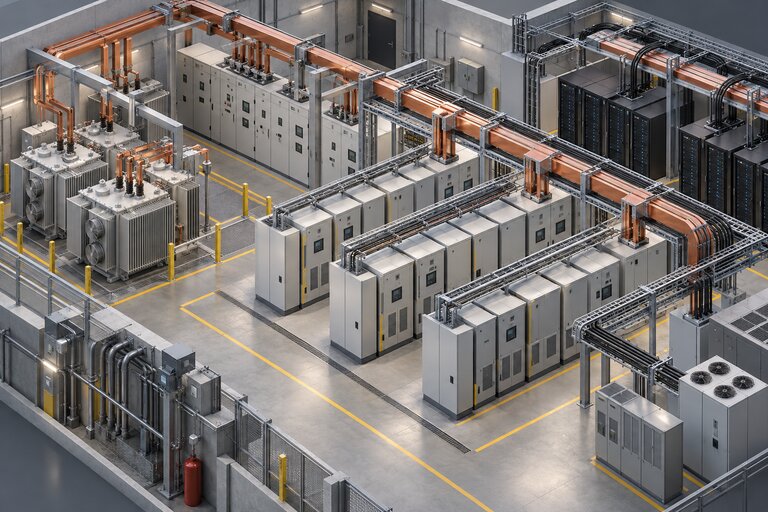
Transformer bank; medium-voltage switchgear; power distribution cabinets; overhead busbars; cable trays; rack PDUs
Description: Transformers, switchgear, uninterruptible power-supply interfaces, power distribution units, copper busbars, and cabling step down and deliver electricity to high-density computing racks.
Environment Impact: Higher-density AI upgrades may force early replacement of existing power-delivery infrastructure. Retired equipment contains substantial copper, metals, insulation, and electrical components that need appropriate assessment and recovery.
For every 100 MW facility:
- 2380 tonnes
- 34% of equipment mass
- 8-year assumed replacement cycle
Backup Power Systems
(The reserve energy behind uninterrupted AI operations)
Description: UPS units, backup battery banks, and standby generators provide continuity during utility interruption while data-center operations transfer between power sources.
Environment Impact: Battery replacement creates material streams requiring specialized handling; lead-acid batteries involve lead and acid, whereas lithium-ion batteries introduce different fire and metal-recovery concerns. Generator servicing also generates regulated oils and fuel-related residues.
For every 100 MW facility:
- 1050 tonnes
- 15% of equipment mass
- 5-year assumed replacement cycle
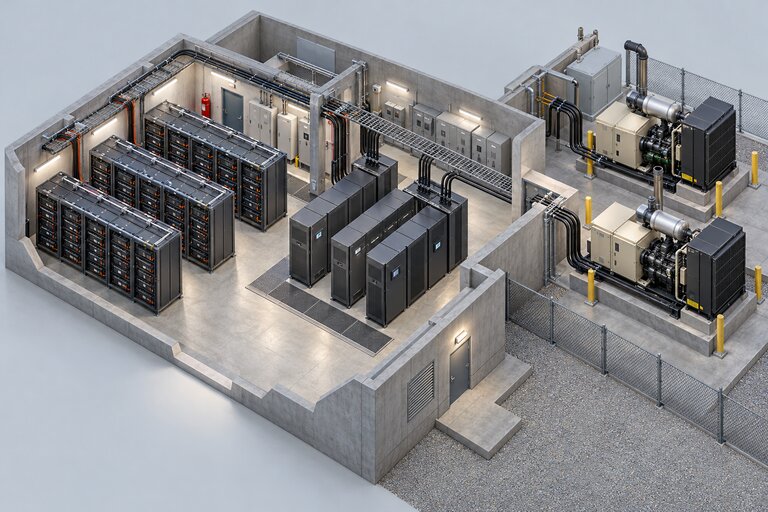
Rows of valve-regulated lead-acid battery cabinets; lithium-ion battery racks; UPS modules; standby diesel generator sets; control cabinets
Cooling Systems
(The thermal infrastructure that makes dense AI computing possible)
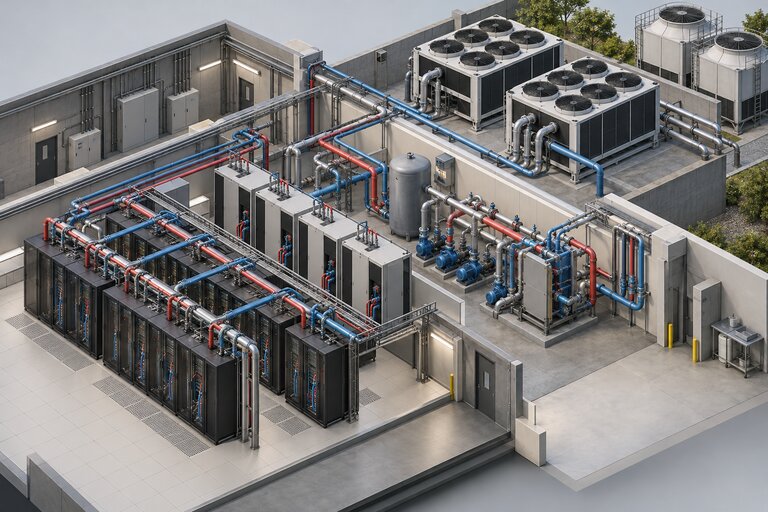
Multiple coolant distribution units; liquid-cooled rack rows; circulation pumps; manifolds; chillers; cooling towers; CRAC/CRAH air handlers
Description: Air and liquid cooling remove heat from computing equipment using chillers, cooling towers, air handlers, coolant distribution units, manifolds, pumps, heat exchangers, and piping.
Environment Impact: Facility retrofits can retire existing air-cooling equipment early. Improper refrigerant management can release potent greenhouse gases; some coolant formulations need managed disposal, and particular fluorinated immersion fluids pose persistent-chemical concerns.
For every 100 MW facility:
- 2450 tonnes
- 35% of equipment mass
- 5-year assumed replacement cycle
Source: Puckett, J. (2026, September). The coming AI waste wave: A white paper in 4 parts. Part I: How big is the AI waste wave? Basel Action Network. https://wiki.ban.org/images/1/16/AI_Waste_Wave_Part_1.pdf
Why And Pollution? To identify actions:
|
|
Food System
|
|
Air
|
|
Freshwater
|
|
Chemical
|
|
Ciruclarity
|
|
|
Financial
|
|
Marine
|
|
Soil
|
|
Transport
|
|
Solid Waste
|