 | And Pollution
Figures
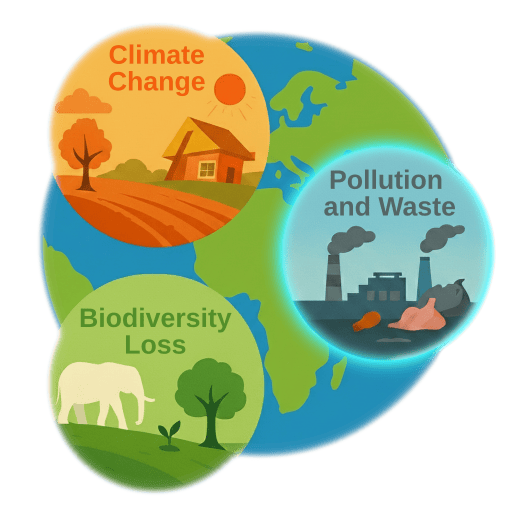
See key illustrative figures from major reports, papers, and resources regarding pollution and waste.









Sources
Cornelis P. Baldé, Ruediger Kuehr, Tales Yamamoto, Rosie McDonald, Elena D’Angelo, Shahana Althaf, Garam Bel, Otmar Deubzer, Elena Fernandez-Cubillo, Vanessa Forti, Vanessa Gray, Sunil Herat, Shunichi Honda, Giulia Iattoni, Deepali S. Khetriwal, Vittoria Luda di Cortemiglia, Yuliya Lobuntsova, Innocent Nnorom, Noémie Pralat, Michelle Wagner (2024). International Telecom- munication Union (ITU) and United Nations Institute for Training and Research (UNITAR). 2024. Global E-waste Monitor 2024. Geneva/Bonn.
Food and Agriculture Organization and United Nations Environment Programme (2021). Global assessment of soil pollution - Summary for policy makers. Rome, FAO. https://doi.org/10.4060/cb4827en.
Health Effects Institute. 2024. State of Global Air 2024. Special Report. Boston, MA:Health Effects Institute.
Kaza, Silpa, Lisa Yao, Perinaz Bhada-Tata, and Frank Van Woerden. 2018. What a Waste 2.0: A Global Snapshot of Solid Waste Management to 2050. Urban Development Series. Washington, DC: World Bank. doi:10.1596/978-1-4648-1329-0. License: Creative Commons Attribution CC BY 3.0 IGO
OECD (2022), Global Plastics Outlook: Economic Drivers, Environmental Impacts and Policy Options, OECD Publishing, Paris, https://doi.org/10.1787/de747aef-en.
Scheringer, M., & Schulz, R. (2025). The state of the world’s chemical pollution. In Annual Review of Environment and Resources, 50. https://doi.org/10.1146/annurev-environ-111523-102318
United Nations Environment Programme (2021). From Pollution to Solution: A global assessment of marine litter and plastic pollution. Nairobi.
United Nations Environment Programme (2024): Global Resources Outlook 2024: Bend the Trend – Pathways to a liveable planet as resource use spikes. International Resource Panel. Nairobi. https://wedocs.unep.org/20.500.11822/44901
United Nations Environment Programme (2024). Global Waste Management Outlook 2024: Beyond an age of waste – Turning rubbish into a resource. Nairobi. https://wedocs.unep.org/20.500.11822/44939
United Nations Environment Programme and Food and Agriculture Organization of the United Nations. 2024. Global Nitrous Oxide Assessment. Nairobi. https://doi.org/10.59117/20.500.11822/46562
W.J. Brownlie, M.A. Sutton, K.V. Heal, D.S. Reay, B.M. Spears (eds.) (2022). Our Phosphorus Future. UK Centre for Ecology & Hydrology, Edinburgh. doi: 10.13140/RG.2.2.17834.08645
WWF UK, 2021: Nitrogen: Finding The Balance Towards A Comprehensive Approach To Nitrogen In The UK, (WWF UK, London, 2022)
United Nations Environment Programme (2024): Global Resources Outlook 2024: Bend the Trend – Pathways to a liveable planet as resource use spikes. International Resource Panel. Nairobi. https://wedocs.unep.org/20.500.11822/44901
United Nations Convention to Combat Desertification, 2022. The Global Land Outlook,second edition. UNCCD, Bonn.
United Nations Environment Programme (2024). Global Waste Management Outlook 2024: Beyond an age of waste – Turning rubbish into a resource. Nairobi. https://wedocs.unep.org/20.500.11822/44939
Why And Pollution? To visualize its global impact:
|
|
Nutrient
|
|
Air
|
|
Freshwater
|
|
Chemical
|
|
Plastic
|
|
|
E-Waste |
|
Marine
|
|
Soil
|
|
Greenhouse
|
|
Solid
|